
Amsterdam • August 28, 1833 – June 27, 1916 • The Hague
Dirk de Graeff van Polsbroek is arguably one of the most consequential diplomats the Netherlands has had in Japan. He laid the foundations for modern Dutch diplomatic representation in Japan, and was the country’s first Dutch minister resident (comparable to a modern ambassador). He helped negotiate treaties with Japan for Denmark, Sweden and Norway, as well as Prussia and Switzerland. He also oversaw the construction of the first purpose-built Dutch diplomatic structure in Japan, the consulate building in Yokohama, completed in 1861. And he was the first foreign diplomat to present his credentials to Emperor Meiji.1
De Graeff van Polsbroek was born into the prominent De Graeff family of Amsterdam, and several of his ancestors were regents, mayors, or city councilors. He, however, saw his future outside Amsterdam.
After having worked for the colonial government in the Dutch East Indies, he moved to the Dutch trading post at Nagasaki’s Dejima in 1857. Here, he became assistant to the Dutch Commissioner in Japan, Jan Hendrik Donker Curtius. He worked on treaty negotiations and accompanied the Commissioner on a trip to Edo for an official visit with the shogun. The experience would serve him well after he became vice-consul in Yokohama in 1859, and later consul, consul general, and minister resident.
De Graeff van Polsbroek was a diplomat at a time when Japan had no experience with modern diplomacy, and the Netherlands did not yet have a system of professional consuls with clear instructions and jurisdiction. Meanwhile, communications between the two countries took many months. During enormous upheaval and change, De Graeff van Polsbroek often had to quickly respond to challenging situations without any guidelines or consultation with the home office.
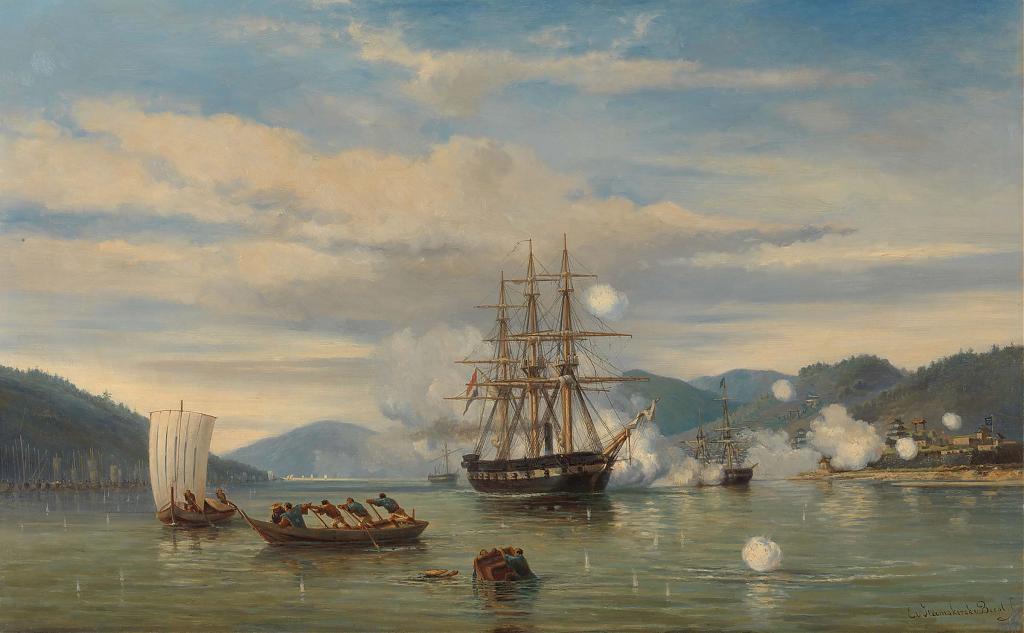
Occasionally, these situations were life-threatening. When the Dutch warship Medusa transported him to Yokohama in 1863, she was bombarded from batteries ashore while in the Strait of Shimonoseki. Four sailors were killed and five wounded. De Graeff van Polsbroek narrowly escaped death. In January 1868, he had to hurriedly escape from Osaka when the city was overrun by the shogun’s enemies. He spent a freezing night hiding from pillaging troops in a fishing hut with paper windows.
Repeatedly, his survival and succes came down to wits, good sense, and creativity.
There is one episode especially illustrative of his unique character and creative problem-solving skills. Japanese customs officials would not allow a Dutch merchant to import a tiger. Tigers were not mentioned in the list of items that could be imported, they argued. De Graeff van Polsbroek told them that the merchant then had no choice but to set the animal free. The tiger was quickly cleared.2
Though eminently capable, De Graeff van Polsbroek had no influence over politics back in the home country. He could therefore not prevent that the Netherlands rapidly lost its special position to Great Britain, France, Germany and the United States while he was representative.
He resigned in 1870, just as the dust was settling in Japan and the foundations of a modern state started to become visible.
Next: 3. Léon van de Polder
Recommended Reading
(Only shown on this site, not in the book.)
- Moeshart, H.J. (2018) Dirk de Graeff and the opening of Japan 1857-1869, Amsterdam/Berlin: De Bataafsche Leeuw
- Moeshart, Herman J. (1987) Journaal van Jonkheer Dirk de Graeff van Polsbroek 1857-1870 : Belevenissen van een Nederlands diplomaat in het negentiende eeuwse Japan, Assen/Maastricht: Van Gorkum
Notes
(Footnotes are only shown on this site, not in the book.)
1 Moeshart, H.J. (2018). Dirk de Graeff and the Opening of Japan 1857-1869. Amsterdam/Berlin: Batavian Lion International, 11.
2 Black, John R. (1940) Young Japan : Yokohama and Yedo, a narrative of the settlement and the city from the signing of the treaties in 1858, to the close of the year 1879 Volume I. Uedaya Shoten, 74, 75. Also: Moeshart, H.J. (2018). Dirk de Graeff and the Opening of Japan 1857-1869. Amsterdam/Berlin: Batavian Lion International, 103. Black mentions two tigers, Moeshart a single one.
Published
Updated
Reference for Citations
Duits, Kjeld (). 2. Dirk de Graeff van Polsbroek, From Dejima to Tokyo. Retrieved on September 17, 2026 (GMT) from https://www.dejima-tokyo.com/articles/54/dirk-de-graeff-van-polsbroek


There are currently no comments on this article.